


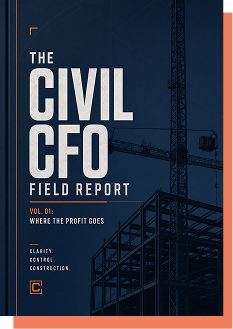
The Civil CFO Field Report · Vol. 01: Where the Profit Goes
Construction Profit Margin: Where It Goes for $20M to $100M Contractors
You bid the job at 22%. It closed at 4% net. We'll show you where the missing points went.
The operating reality
The 5 quiet leaks bleeding construction profit
5
28
10%+
Leak 01
Estimating gaps
Estimating gaps that bake the loss in before mobilization
The first place margin disappears is before the job even starts. The bid log says 22 percent gross. The unit prices look reasonable. Everything looks normal. Then we pull the equipment rates, the indirect costs, and the contingency line. The bid was underpriced before anyone left the office.
Equipment rates that don't cover the equipment. Most contractors price equipment to cover fuel, operator wages, and a token rate. They miss depreciation, maintenance, idle time, and the cost of the capital tied up in the fleet. One earthwork contractor we worked with hadn't adjusted his rates in four years. He was 18 percent underpriced on equipment-heavy jobs.
Indirect costs nobody allocated. Unbilled PM time, supervision across sites, equipment moves, and yard time rarely show up in a unit price. Another earthwork contractor we worked with added $200,000 of indirect cost to the first bid he built with an allocation model. That cost had been eating his margin on every job before it.
Contingency that isn't there. A steel fabricator we worked with had been in business 20 years and never put contingency in a bid. Every overrun came straight out of profit. He thought he was bidding lean. He was bidding short.
Risk doesn't get cheaper because you didn't price it.
Leak 02
Profit fade
Profit fade: cost creep that hides in the WIP schedule
Profit fade is the gap between the margin you bid and the margin you landed when the job closed. When it's negative job after job, you don't have a job problem.
You have a system problem.
Costs don't blow up all at once. They creep. A little extra labor here, a material price that moved, a week of weather, a piece of equipment that sat. None of it is alarming alone. It stacks over the life of the job, and the first place it shows up is your WIP schedule.
WIP, or work in progress, is the table that shows every active job, what you've billed, what you've earned, and the gap between them. It's the closest thing construction has to a fuel gauge. If your estimated cost to complete keeps climbing month over month, your profit is shrinking while you work, and the WIP tells you before the P&L does.
The report walks through how that monthly review runs, who sits in the room, and what it catches.
Leak 03
Change orders
Change orders that get built but never get billed
"Hey, while you're here, can your guys knock out this extra section?"
"Yeah, no problem, we'll get it done."
The crew does the work Friday. Good work. The customer is happy. The invoice never gets written, because nobody told the office it happened. Three months later the job closes a few points under estimate and everybody scratches their head.
That's not a one-off. That's how a year loses two points of net.
Even when change orders do get billed, they often get billed wrong. Owners price the base contract at a healthy markup, then price change orders at cost or close to it, because it feels small and nobody wants to nickel-and-dime the customer. So the unplanned work, the work carrying the most risk, runs at a worse margin than the work you bid.
A change order should add profit, not drain it. The authorization rule and markup standard that fix this are in the Field Report.
Volume 2 covers the cash side of change orders and six other places cash gets stuck. Read Where the Cash Hides.
Leak 04
Procurement
Procurement and buyout slip after award
The fourth place margin disappears is the window between award and mobilization, when most contractors stop pushing on price.
The award comes in. The PM pulls the sub quotes from the bid file and honors them. Materials get ordered at bid prices. Work starts. What gets skipped is the buyout: going back to subs and vendors once you have the contract, when they want the work badly enough to sharpen their pencils.
One commercial facility services contractor we worked with had never gone back to the market after award. We set a simple rule: at least two competitive prices per major trade, with the original bidder given the chance to match. Inside one quarter, sub pricing came down 4 to 6 percent across the board. If nobody on your team produces a buyout report at mobilization, those savings are invisible, and nobody is fighting for them.
Leak 05
Wrong jobs
The wrong jobs taken in the first place
The fifth blind spot is the one owners find hardest to accept. Some jobs were never going to make money at a margin you can live with, and most contractors have no system for saying no to them.
Sales brings the opportunity. The estimator prices it. The bid goes out. Nobody asks whether it should have been bid at all.
One earthwork contractor we worked with had been bidding everything for two years. Win rate crept up. Margin crept down. He thought he had a margin problem. He had a bid problem. After we installed a no-bid process, he passed on 40 percent of the work he would have chased. Revenue dropped 12 percent. Net margin grew by more than the revenue he gave up.
Revenue is not profit. The contractors who hit top-quartile margin are the ones whose no-bid pile is thicker than their bid pile. Volume 3 goes deeper on this in January 2027.
What's inside the 28-page Field Report
This isn't theory. It's the working playbook our Fractional CFOs use with clients to push net margin toward 10% and up.
- The five blind spots, each with what we've seen across our clients, what it typically costs a $20M to $40M contractor, and a self-check to see if it's yours
- The change order rules that stop unbilled and underpriced extra work
- A full case study: a $32M heavy civil contractor that moved from 2.9% to 8.1% net in 12 months
- The Margin Scorecard: score your company on all five areas in 15 minutes and find your biggest leak
- A one-page action plan to turn your lowest score into one change, one number to watch, and one owner
Send me Volume 01
Get the PDF now. We'll send each new Field Report when it comes out.
Frequently asked
We run the forward-looking side of your finances. That means a 13-week cash forecast so you see trouble before payroll does, a monthly WIP review that catches fading jobs while there's still time to fix them, a balance sheet your bank and surety want to say yes to, and pricing that turns busy into profitable. Your bookkeeper and CPA keep doing what they do. We make their numbers useful to you.
Usually when the business outgrows the systems that built it. Several big jobs running at once, heavy equipment debt, retainage tying up cash, and net margin stuck at 1 to 3 percent even though you're busier than ever. Most owners start feeling it after they cross the $10M Wall. By $20M, it's costing you every month.
No. We don't do bookkeeping, tax, or accounting, and we don't replace your controller or CPA. We work alongside them. They keep the books. We use those numbers to tell you what's coming and what to do about it.
A bookkeeper records what happened. A controller makes sure it was recorded right and produces your financial statements. A Fractional CFO uses those statements to look ahead: where your cash will be in 13 weeks, which jobs are fading, and what your bank and surety need to see before they say yes.
We work only with single- and family-owned construction companies doing $20M to $100M in revenue: heavy civil, earthwork, general contractors, and specialty trades. If you're under $20M, clean bookkeeping will probably do more for you than a CFO.
The missing points aren't a mystery.
They aren't a hustle problem either. You're already working hard enough. The margin leaks in five specific places, and the contractors who pull away from the pack are the ones who decided to watch those five places on purpose. Read the report. Run it with your team. Find your leak.
If you want people who have sat in the CFO seat of eight- and nine-figure contractors to work through your numbers with you, that's what we do. We work only with $20M to $100M construction companies, single- or family-owned, moving from 1 to 3% net toward 10% and up. If that sounds like your business, the next step is a Discovery Call. We'll walk through where you've been, where you are, and where you want to go.